This post is also available in:
 Italiano (Italian)
Speaking of animals in Southeast Asia, I thought I’d see more of them on this trip. I actually did see them, but mostly in a short amount of time and within a few meters!
The symbol of Singapore is the statue—half lion, half fish—located in the bay, since the very name “Singapore” comes from the word “lion,” which, according to legend, was spotted in this area by the city’s founder. Too bad no lions have ever been seen here. In Singapore, the only animals seen in the wild have been hens and roosters wandering around the city’s parks.

Animals in Southeast Asia: The Malaysian Tiger
Another animal one might expect to find but that has never been present in a certain territory is the tiger in Borneo. Historically, this big cat has always existed on the Malaysian peninsula, but never in the area where Emilio Salgari set many of the adventures of Sandokan, who was even nicknamed the Tiger of Malaysia.
Before leaving, I had watched the Italian TV series based on the novels featuring the famous pirate. The one from the ’70s is certainly a bit naive—for example, in the fight scenes—but I like it better. The more recent one is very well made, but it doesn’t manage to convey the same sense of epic grandeur as the first one. On my trip, I read three of the best-known novels.
The Italian writer wrote countless novels—even ones not featuring Sandokan—set in distant lands he had never seen. His sources were the books and publications he found in the libraries of Verona and Turin, places he had never left. It’s hard to say whether—due to the inaccuracy of his sources, by mistake, or for narrative purposes—there are so many inaccuracies, whether geographical, historical, or related to nature.
Despite his fame, Emilio Salgari led a very unfortunate life that ended in suicide.

Kuching—not a very exotic name
In the novels I’ve read—as is generally the case with many 19th-century works—a certain racism toward non-Westerners is evident, and there is certainly no compassion toward animals. Sandokan and his friends, despite being heroes of high moral character, actually enjoyed slaughtering innocent animals just for fun.
Another aspect I find hard to tolerate in novels from that period is the excessive romanticism. Sandokan stubbornly sets out on a mission, dragging his men along and causing dozens of them to be killed, just to go and rescue a girl he barely knows. And before he’s even seen her, he’s already set his mind on it, simply because he’s never seen a blonde girl (the Pearl of Labuan). Not to mention the fact that she’s only 13 years old!
One of the villains in *Sandokan* (a truly evil one) is inspired by the real-life James Broocke—a very interesting figure, well-liked by the people, though less so by the pirates he fought tenaciously. He lived in what is now Kuching, where the mansion rebuilt by his grandson still stands. In Salgari’s novels, however, this city is never mentioned—perhaps because its name isn’t very exotic?

My Encounters with Animals in Southeast Asia
Anyway, I didn’t see any Labuan pearls, but I did see one of the things I’d set out to see on this trip: a proboscis monkey!

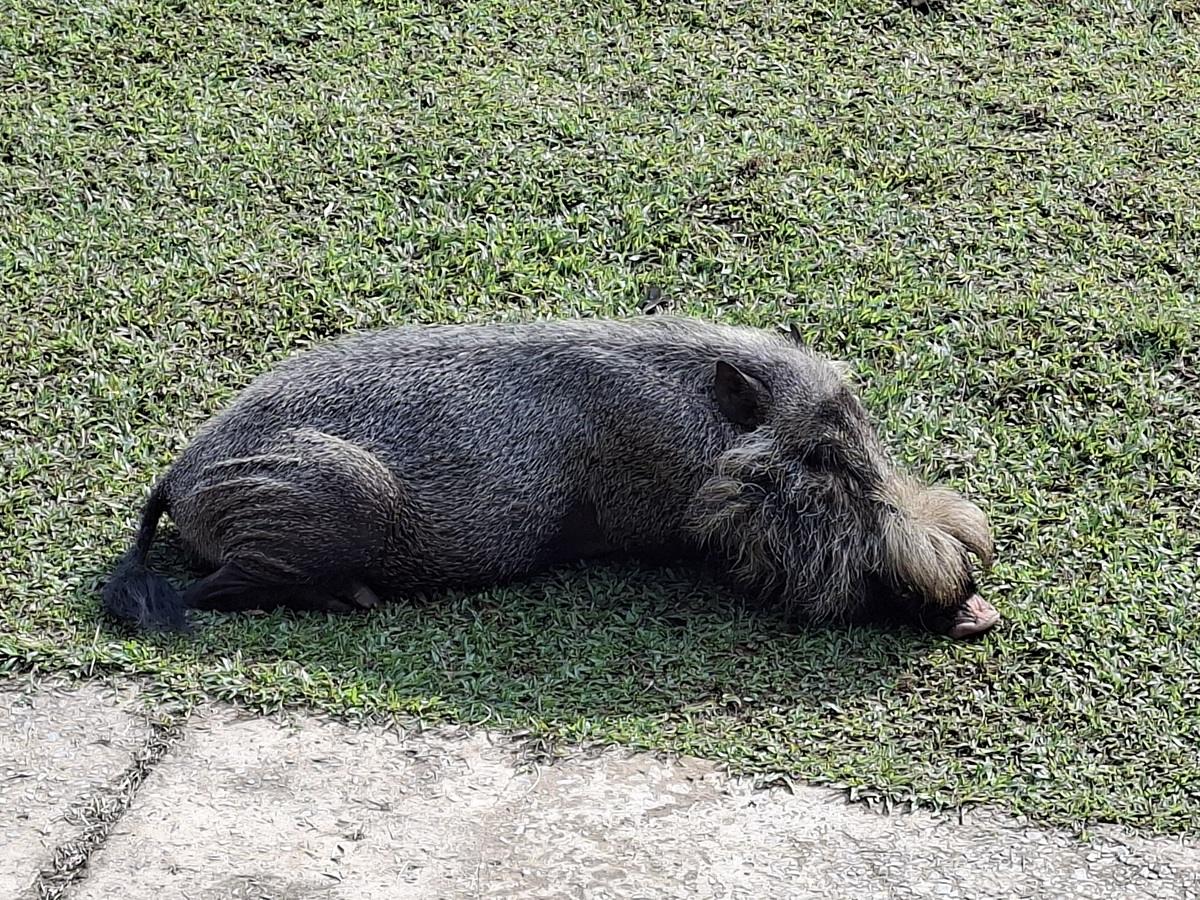
The proboscis monkey is one of the funniest animals, and the males, with their big noses and bellies, look very human—especially because of their expressive faces. Another funny animal that I enjoyed seeing up close is the bearded pig.


The reason for my trip to Bako National Park was specifically to see these monkeys. I went there and then explored on my own by bus and small boat, since it’s not accessible by land. It’s a forested area right by the sea; along the coast, there are mangroves and crocodiles! The inland area can be explored via well-marked trails. When I planned the trip, I’d intended to do the longest hike, but a subsequent knee problem led me to opt for shorter walks closer to the starting point and the visitor center.
The hikes satisfied me in terms of the experience of walking through the jungle—including the exertion caused by the humidity—and the beautiful coastal views. But I didn’t see any animals, except for the curious bearded wild boars.
Tired, resigned, and sad that I hadn’t spotted any nasonas, I found one right on the tree closest to the building housing the restaurant and the visitor center. She was sleeping soundly, then she woke up, and I was even able to watch her eat.
Links
Travel Home: Trip to Malaysia and Singapore
Previous stop More videos from Singapore
Next Stop : Animals in Malaysia: Some Videos of the Proboscis Monkey, Too

Trips taken, travel stories divided by continent
Countries visited in my travel stories
Anecdotes, divided by type in travel narratives


Leave a Reply
You must be logged in to post a comment.