This post is also available in:
 Italiano (Italian)
Before leaving, getting around by public transportation in the Caucasus seemed like it might be a problem. I’d read in various sources about the dreadful marshrutkas—ramshackle minibuses dating back to the Soviet era. Even people I know have told me about stops in the middle of nowhere; about being surrounded by smoke filling the passenger compartment; about being abandoned on the road; or, for those who had rented a car, about wandering through the steppe with a gas can in search of fuel.
None of that happened to me; maybe I’m lucky, or maybe, after my experiences in Senegal, nothing fazes me anymore: Traveling on Your Own in Africa: Unique Public Transportation

Public transportation in the Caucasus, as well as tours
One of the most entertaining aspects of the trip was discovering that in all three countries, there’s a real passion for customizing license plates. Many feature symmetrical digits and numbers, repeated sequences, or combinations that clearly hold special meaning for their owners. If it were easier and more affordable to do this in Italy, I’d choose FA 810 GO or IO 101 OI.

Since I only had a few days, I chose to take a day tour from the capital in all three countries so I could have more experiences. A couple of times, the service wasn’t the best. For example, in Azerbaijan, to get us to visit the usual artisans that every tour stops at, they made us eat (a small meal) at 3:00 p.m.

Day Trip from Baku
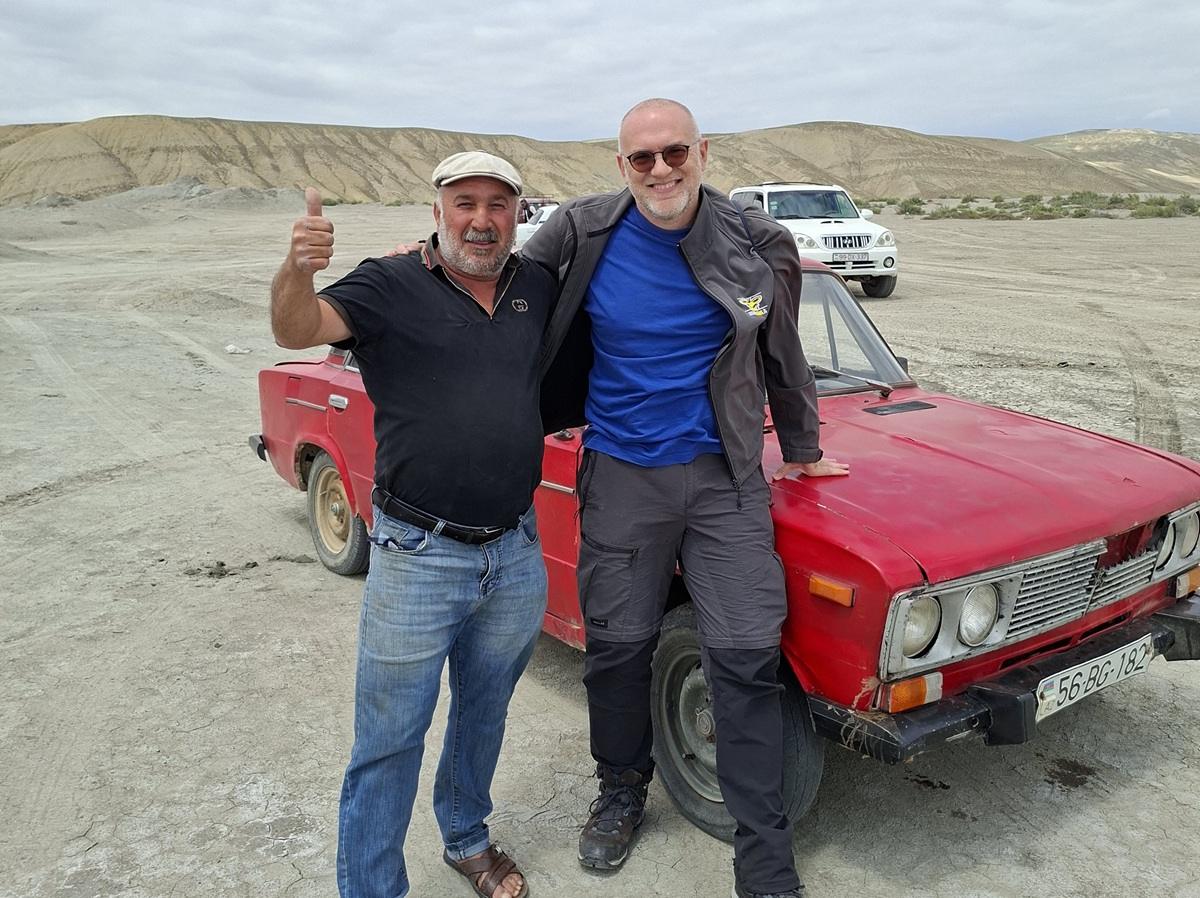
The memorable moment from my experience traveling by public transportation in the Caucasus is captured in the featured photo, taken by the driver who called himself the “Schumacher of Azerbaijan.”
When he told us that the beat-up Lada we were riding in was from ’84, the three very young Chinese guys who were with me couldn’t believe it. Between one jolt and the next, they laughed nonstop for 10 minutes, all the way to our destination, the mud volcanoes.
Actually, they’re small mounds from which hot mud oozes out; it seems as if the earth is bubbling. I saw the same phenomenon in the province of Modena, Italy, as well. But the short ride to get there was a lot of fun—it felt like being on a roller coaster, and every now and then our driver had to stop for various maintenance tasks.

On this trip that started in Baku, we also saw other interesting things, including some modern buildings on the outskirts of the city:
- oil wells (reportedly the first in the world)
- a place where eternal flames rise from the ground (like Mount Busca in Romagna)
- The Petroglyph Reserve (rock art dating back 12,000 years)

Getting Around by Public Transportation and Crossing Borders
As is often the case for me, I was very pleased with my choice. Getting around by public transportation (especially buses) is also the best way to immerse yourself in the local culture. One exception was the trip from Azerbaijan to Georgia, which was only possible by plane. All land borders are closed, and following the recent war, it is forbidden to travel to Armenia from Azerbaijan. Here is a link to learn more about the only Muslim (but decidedly secular) country among the three Caucasian nations.

One thing that particularly struck me about the ultra-modern Baku airport was the vending machines and food courts. I wanted to use up the little change I had left, but I had trouble because they don’t sell chewing gum or candy there.
I was also a little worried about the trip from Tbilisi, the capital of Georgia, to Dilijan in Armenia. The only agency I’d found had terrible reviews. But everything went well—even crossing the border and boarding the Armenian vehicle. The only problem was the driver, who was talking very loudly with an Armenian passenger. The three countries have completely different languages and even alphabets. Very few people speak English; many speak Russian.
I happened to chat with some other foreign passengers, like the Filipino guy who described a public restroom to me in one word: terrible. Yeah, that’s right—gas stations, and especially the restrooms, aren’t exactly inviting.

Getting around by public transportation in the Caucasus isn’t taboo
I’ve also used public transportation on other occasions, like when I went to see the church in Mtskheta, near Tbilisi. I have to say, it’s not worth it. Getting around by public transportation in the Caucasus can even have its drawbacks.
It took me a long time, mainly because I couldn’t find the right bus stop. I asked several people, and they sent me back and forth between two nearby stops, so I finally gave up and took a taxi.

On the way back, however, I easily found the only bus stop in the small town. So while there isn’t much information available, the public transportation isn’t that run-down, and the stop had a digital display showing real-time schedules and the option to pay by tapping a credit card.
To sum up, I would describe public transportation in the Caucasus as both contradictory and growing.

Links
This is the homepage for the videos from this trip: Next stop, the Caucasus!
First Stop : Anecdotes and Accommodations—The Hotel in Baku Is No Longer There
Next Stop : Encounters Along the Way: What a Beautiful City Tbilisi Is!

Finally, links to the general pages into which I have divided my articles:
Trips taken, travel stories divided by continent
Countries visited in my travel stories
Anecdotes, divided by type in travel narratives


Leave a Reply
You must be logged in to post a comment.