This post is also available in:
 Italiano (Italian)
Encounters with stray dogs were my main concern at the start of my trip to the Caucasus. I had read some rather alarming accounts about their aggressiveness. In the past, I’d had only one nearly negative experience, and that was in Thailand. Elsewhere, I’d had no problems, even though I’d encountered many of them, especially in South America.


When I arrived in the area, however, I saw mostly cats—roaming freely and well cared for. In downtown Baku, there are several colorful little houses (cat houses) for the cats. I also saw several kittens.
During this trip, I read *A Lost World* by the mountaineer, traveler, and journalist Walter Bonatti. His book is a must-read for anyone interested in travel and nature. I also consider him a kind of superhero. Some of his feats—often undertaken solo and given their physical demands—I believe would have been impossible for at least 99% of the world’s population. This is especially true when you consider the resources available in the 1960s and 1970s.
As I read Bonatti, I find comfort in thinking about my encounters with stray dogs
In the book I read during those days, Bonatti made me think a lot about wild animals, people, and travel. Even back then, he argued that mass tourism was inexorably altering both the destinations and the people—particularly the residents of new tourist destinations, who were becoming morally corrupt in their quest to capitalize on the new revenue streams.
Decades have passed since his first remarks, and the situation has certainly worsened. Today’s travelers often delude themselves into thinking they’re having authentic experiences—perhaps by watching the lackluster dance in a Masai village that comes to life only when tourists pass by, or by haggling over trinkets made in China. And then, back home, they talk about how kind those people are, when in reality they’re seen only as gullible walking wallets to be fleeced as much as possible.
In one of the stories, Bonatti tries to approach the crocodiles in a river, convinced that they won’t be interested in him. I tried to imagine that this idea would be useful to me, too, when I encountered stray dogs.
In Azerbaijan to some extent, and especially in Georgia and Armenia, encounters with stray dogs are quite common, even in cities. I got the impression that there were few of them only in Yerevan, the busiest city.
But running into them when there are other people around you really isn’t a cause for concern. They usually mind their own business; at most, I’ve seen them arguing among themselves. Only in Tbilisi, in front of a McDonald’s, did one of them seem to have it in for me. Maybe because he knew I was just going in to use the restroom and had no intention of buying anything? Before leaving, I checked to see if he was still around, but he was gone.
It would have been quite different to encounter them on my own, out in nature.
Encounters with stray dogs while hiking and having breakfast
I spent two nights in Dilijan, in what some crazy people call the “Switzerland of the Caucasus.” I had planned to go hiking. I would have considered a guided tour, but nothing was organized, and the trail—rated as easy and well-marked—started right from the village. The forecast called for rain around lunchtime, so I set out planning to walk for a couple of hours and then head back.
After just half an hour, without having seen anyone and deep in the woods, I catch a glimpse of them in the distance; there are three of them. I decide to turn back—the trail is narrow and steep, and there’s no way to get around them.
After a short while, I hear them running toward me. I don’t even have time to feel anything—it’s obvious they’re friendly. They greet me enthusiastically and even squabble a bit to get my attention. I resume walking, and they turn around too; they want to escort me into their territory. Like most stray dogs, they aren’t exactly in good shape. One is limping, while the leader is blind and leads the way by holding on. They accompany me for a while, then stop and watch me as I walk away.

The next morning, before heading out again by minibus to Yerevan, I stop at one of the vending machines on the street. It’s the only way to get a coffee before 9 a.m.; it costs just a few cents and is actually pretty good. Another dog approaches me—this one’s pretty lame, too. It curls up beside me near the nearby bench. When I get up and start walking toward the bus station again, it follows me and stays with me for a while; shortly after, another dog joins the cheerful little group.

Last Days in Armenia


I spent the last part of my trip in Armenia, a country rich in history whose people have been severely mistreated throughout history. The capital, Yerevan, isn’t ugly, but—especially compared to other capitals in the region—it lacks character and has nothing particularly noteworthy to offer.
The most popular area is called the Cascata . It’s a rather steep staircase with a garden and several works of art. Among these, the statue of the architect who designed it stands out, resembling a DJ busying himself with the mixer and turntables. I especially liked the statues of Fernando Botero , whom I adore.

But what I like even more about Yerevan is its proximity to the looming, biblical Mount Ararat, which is always in the background—almost always snow-capped but also often shrouded in clouds. We got a closer look at it during the fascinating tour, but not close enough to find Noah’s Ark, since it’s located in Turkish territory and the border in that area is closed.
These were the other stops on the tour.
- Khor Virap Monastery (with the best view of Mount Ararat)
- Garni Temple
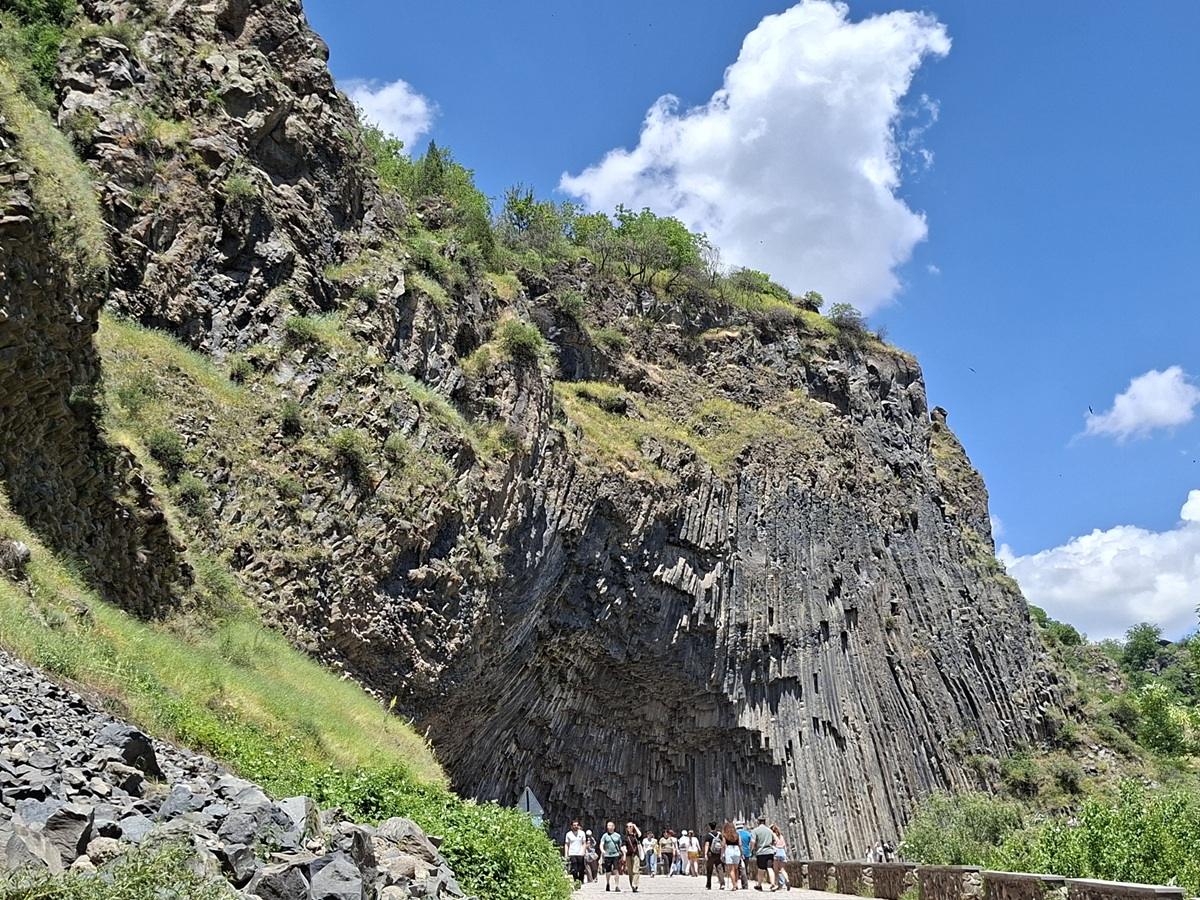
- Symphony of Stones
- Geghard Monastery

The majestic ” Symphony of Stones ” (featured photo) is a unique formation of basalt rocks; its name comes from the fact that they resemble countless organ pipes.

Links
This is the homepage for the videos from this trip: Next stop, the Caucasus!
Previous Stop : Encounters Along the Way: What a Beautiful City, Tbilisi!

Finally, links to the general pages into which I have divided my articles:
Trips taken, travel stories divided by continent
Countries visited in my travel stories
Anecdotes, divided by type in travel narratives


Leave a Reply
You must be logged in to post a comment.